22.2.2013: Colliders Unite: Linear Colliders in New Partnership
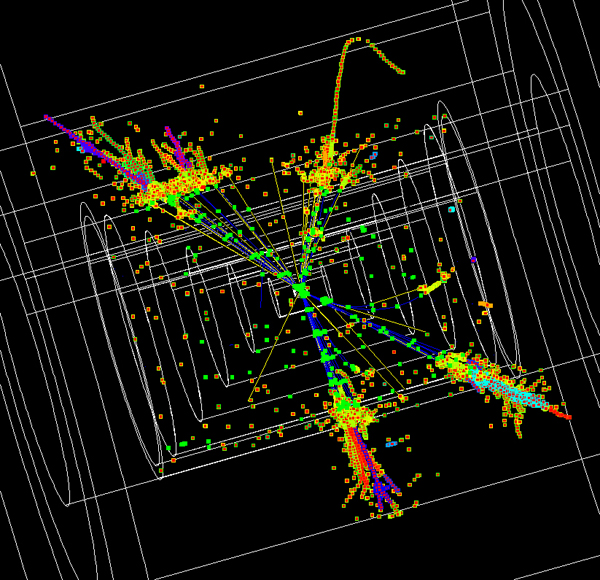
A simulation of the decay of a Higgs boson in a linear collider detector. (Image courtesy of Norman Graf.)
On 21 February 2013 at 4pm PST, the Linear Collider Collaboration announced a new partnership between two studies for next-generation particle colliders aimed to complement the Large Hadron Collider (LHC) at CERN and strengthen worldwide efforts to understand the universe through particle physics.
The International Linear Collider Collaboration will include the International Linear Collider (ILC) led by Mike Harrison of Brookhaven National Lab in the US, the Compact Linear Collider (CLIC) led by Steinar Stapnes at CERN and a section devoted to research for physics and detectors led by Hitoshi Yamamoto of Tohoku University in Japan.
Lyn Evans, former Project Leader of CERN's Large Hadron Collider, will head the collaboration. "There are a lot of areas where the ILC and CLIC are very similar,” says Evans. “Now we will bring the two groups together in a project where they can actually collaborate."
11.2.2013: Long Shutdown: Exciting times ahead

Over 10,000 high-current splices between LHC magnets will be opened and consolidated during the first Long Shutdown of the LHC. This image shows their installation in 2007 (Image: CERN)
The Large Hadron Collider (LHC) has provided physicists with a huge quantity of data to analyse since the first physics run in 2009. Now it's time for the machine, along with CERN's other accelerators, to get a facelift. "Long Shutdown 1" (LS1) will begin on 14 February 2013, but this doesn't mean that life at CERN will be any less rich and exciting. Although there will be no collisions for a period of almost two years, the whole CERN site will be a hive of activity, with large-scale work under way to modernize the infrastructure and prepare the LHC for operation at higher energy.
30.01.2013: Apply now for Google Science Fair 2013
Today marks the start of the third annual Google Science Fair, in partnership with CERN, National Geographic, LEGO and Scientific American. The Google Science Fair is the largest online science fair in the world. It is an international competition that encourages students between the ages of 13 to 18 all over the world to perform science experiments or create engineering projects to submit online, in order to compete for prizes, scholarships and once-in-a-lifetime experiences.
Find out more about the programme and how to apply on CERN's new website.
28.01.2013: Superconductivity leads the way to high luminosity

New superconducting links developed to carry currents of up to 20,000 amperes are being tested at CERN (Image: CERN)
As the LHC nears the end of its first long run – from March 2010 to March 2013 – work towards the proposed first major upgrade is gathering speed. Around 2020, the LHC could extend its potential for discovery through a fivefold increase in luminosity beyond the design value, in a new configuration called the High Luminosity LHC (HL-LHC).
23.01.2013: Apply now for CERN's Summer Student Programme
Students! The deadline for applications for CERN's Summer Student Programme 2013 is 31 January at 00.00 CET. Find out more about the programme and how to apply on CERN's new website.
25.01.2013: Carrying the force: Thirty years of the W boson
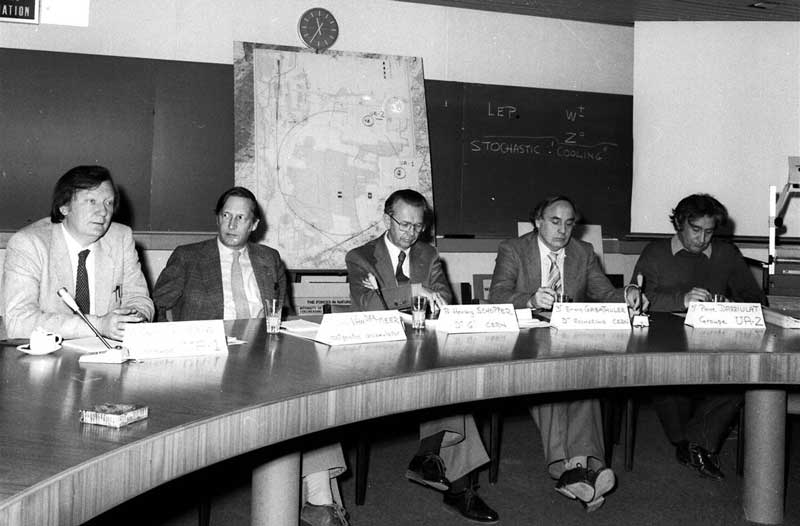
At a press conference on 25 January 1983, CERN announced to the world the discovery of the W boson (Image: CERN)
30 years ago today, CERN physicists announced to the world the discovery of the W boson.
The electrically charged boson is an elementary particle that carries the weak force, one of four fundamental forces in physics. The discovery came after just three years of research with CERN's Super Proton Synchrotron – a machine originally designed to accelerate beams of protons – running as the world's first proton-antiproton collider.
22.01.2013: ALICE scrutinizes lead-proton run for quark-gluon plasma
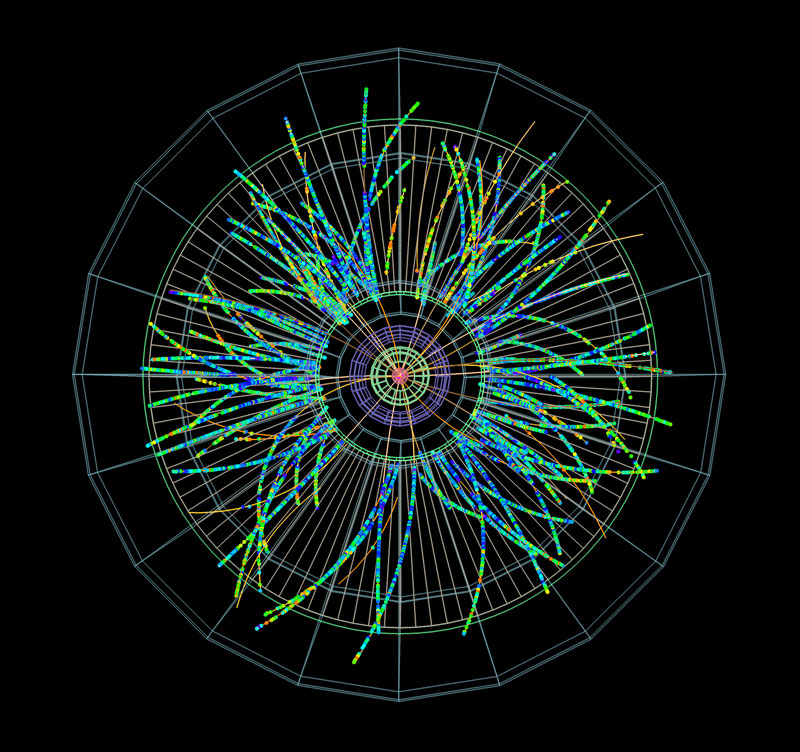
Protons collide with lead ions in the ALICE dectector in the first LHC physics beams of 2013 (Image: CERN)
ALICE, a specialized heavy-ion detector on the LHC, will be watching the lead-proton collisions closely to tease out the effects of lead ions from the effects of quark-gluon plasma. The LHC experiments ATLAS, CMS and LHCb are also taking data.
21.01.2013: Protons smash lead ions in first LHC collisions of 2013

The first proton-lead collisions of 2013 send showers of particles through the ALICE detector (Image: CERN)
The LHC accelerator team declared "stable beams" yesterday as lead ions collided with protons in the first LHC physics beams of 2013.
16.01.2012: Preparing the LHC for the lead-proton run
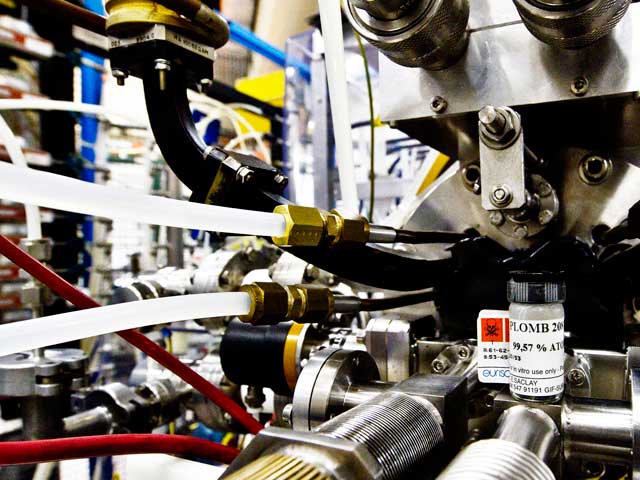
This small bottle contains the lead source for Linac 3, which provides lead ions for collisions in the LHC (Image: CERN)
For its last run before a two-year shut down, the Large Hadron Collider (LHC) is going to go beyond its design specification and collide protons with lead ions, as it did in a trial run last September.
14.01.2012: Antimatter experiments present progress
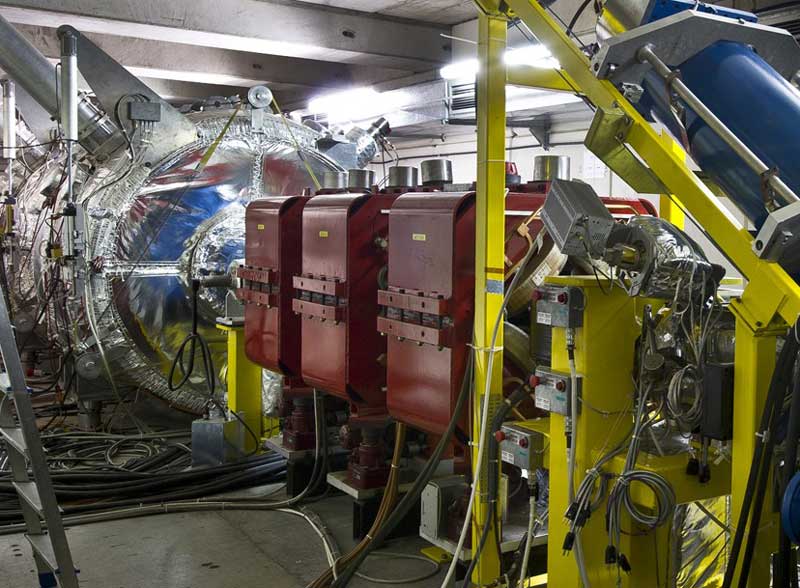
The Antiproton Decelerator provides beams of low-energy antiprotons to experiments, mainly for studies of antimatter (Image: CERN)
At CERN today, representatives of the experiments that use beams from the Antiproton Decelerator presented their progress in 2012, and their plans for the New Year.
21.12.2012: Highlights from CERN in 2012
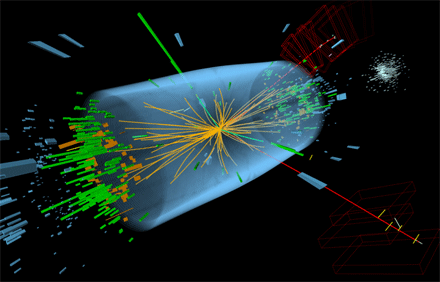
A candidate event in the search for the Higgs boson, showing two electrons and two muons (Image: CMS/CERN)
"[This year] will go down in history as marking the first of the LHC's major discoveries, a defining moment in the history of science," says Director-General Rolf Heuer in his end-of-year message to CERN people.
20.12.2012: This month in 1991: The web spreads beyond CERN
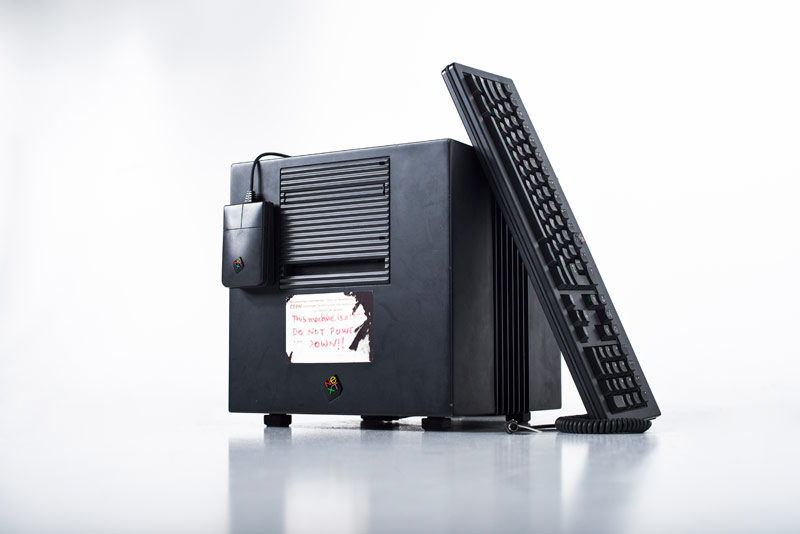
The world's first web server, Tim Berners-Lee's NeXT machine at CERN. The hand-written sticker reads: "This machine is a server. DO NOT POWER DOWN!" (Image: CERN)
Twenty-one years ago this month, physicists at the Stanford Linear Accelerator Center (SLAC) in California installed the first web server outside of Europe. The move marked the beginning of the global reach of the World Wide Web, a key point in the history of digital communications.
18.12.2012: CERN DG meets with Ban Ki-moon

United Nations Secretary-General Ban Ki-moon (left) and CERN Director-General Rolf Heuer (Image: Evan Schneider/UN)
On 17 December CERN's Director-General, Rolf Heuer, met with Ban Ki-moon, Secretary-General of the United Nations (UN). Their meeting follows CERN's accession to status of observer at the United Nations General Assembly on 14 December. The two leaders discussed CERN's new status and how the laboratory can contribute to the Assembly's work. Rolf Heuer pledged that CERN was willing to actively contribute to the UN's efforts to promote science. In particular, CERN can help with the 'Science for sustainable development' initiative coordinated by UNESCO, and with objectives of the post-2015 agenda.
CERN, founded under the auspices of UNESCO, maintains strong relations with several UN institutions. CERN and UNESCO, for example, lead knowledge dissemination projects in developing countries. CERN's accession to observer status to the UN General Assembly strengthens these efforts to share scientific knowledge across nations.
17.12.2012: LHC proton run ends with new milestone
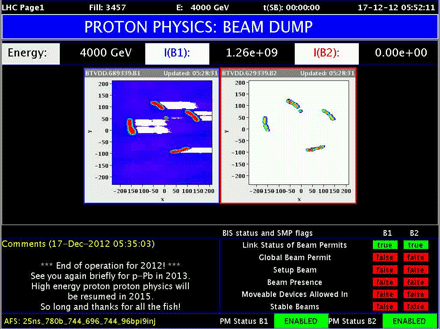
The final beam of the three-year proton run at the LHC is dumped, with the phrase "So long and thanks for all the fish" from the control team (Image: CERN)
This morning CERN teams brought the first proton run at the Large Hadron Collider to and end with the message "So long and thanks for all the fish," - a phrase made famous by British writer Douglas Adams in his Hitchhiker's Guide to the Galaxy series. The remarkable first three-year run of the world's most powerful particle accelerator was crowned by a new performance milestone. The space between proton bunches in the beams was halved to further increase beam intensity and the accelerator's luminosity.
"This new achievement augurs well for the next LHC run starting in 2015," says CERN's head of accelerators and technology, Steve Myers. "High-intensity beams are vital for the success of the LHC programme. More intense beams mean more collisions and a better chance of observing rare phenomena."
Of the 6 million billion proton-proton collisions generated by the LHC, the ATLAS and CMS experiments have each recorded around 5 billion collisions of interest over the last three years. Of these, only around 400 produced signatures compatible with the Higgs-like particle whose discovery was announced in July.
Read more
17.12.2012: CERN granted status of observer to the United Nations General Assembly
On Friday the United Nations General Assembly in New York adopted a resolution granting CERN observer status. This status gives the organization the right to participate in the work of the General Assembly and to attend its sessions as an observer.
"It's a great honour for CERN to accede to the status of observer at the UN General Assembly", said CERN Director-General, Rolf Heuer. "CERN has a long tradition of close cooperation with the United Nations and its agencies, which dates back to 1954 when the laboratory was founded under the auspices of UNESCO". In addition to this historical link, CERN has signed cooperation agreements with the United Nations Office at Geneva (UNOG) and several of the UN specialized agencies.
The resolution to grant observer status to CERN was submitted by the organization's two Host States, Switzerland and France, and was supported by its eighteen other member states as well as by several non-member states. The main factor behind it was that CERN's activities cover areas of considerable interest to the General Assembly. CERN and the United Nations are both actively involved in disseminating knowledge in the fields of science and technology, particularly with a view to development. Through its projects, which bring together scientists from all over the world, CERN also promotes dialogue between nations and has become a model for international cooperation.
Read more
13.12.2012: LHC and experiments give round-up of first three years
Representatives of the Large Hadron Collider (LHC) and five of its experiments delivered a round-up report to the CERN Council this morning. The ATLAS and CMS experiments presented a wide range of results, including sensitive searches for new physics. The highlight from the LHCb experiment was a measurement of one of the rarest processes so far observed in particle physics, the decay of a Bs (pronounced B-sub-s) meson into two muons. Measurements of rare decays provide important tests of the Standard Model of particle physics, and are good places to look for new physics beyond the Standard Model. The highlights from the ALICE experiment's first three years are detailed studies of the quark-gluon plasma, QGP, the matter of the primordial universe. Measurements from the TOTEM experiment give insights on the structure of the proton and provide input to the analyses of the other LHC experiments. All the experiments congratulated the LHC on its exemplary performance over its first full three years of running.
With the Milner Foundation's Fundamental Physics Prize being awarded to seven scientists from ATLAS, CMS and the LHC earlier in the week for the discovery of a Higgs-like particle, all eyes were on CMS and ATLAS. Each experiment reported that the significance of its observation now stands close to the 7 sigma level, well beyond the 5 required for a discovery, and that the new particle's properties appear to be consistent with those of a Standard Model Higgs boson. They are both careful to say, however, that further analysis of the data, and a probable combination of both experiments' data next year, will be required before some key properties of the new particle, such as its spin, can be determined conclusively. The focus of the analysis is now moved from discovery to measurement of the new particle in its individual decay channels.
The measurements reported by both experiments show that the new Higgs-like particle is in good health with a mass of around 125 GeV, but much further analysis is needed to reveal the full details of its identity. The next update is scheduled for the spring 2013 conferences, but for the final word before the LHC resumes running in 2015, we'll probably have to wait some time longer.
13.12.2012: Fundamental Physics Prize honours leaders at ATLAS, CMS and LHC
Lyn Evans, Peter Jenni, Michel Della Negra, Fabiola Gianotti, Jim Virdee, Guido Tonelli, and Joe Incandela on winning the special Fundamental Physics Prize, and what they may do with the money (Video: CERN)
The Fundamental Physics Prize foundation today announced that a $3,000,000 special Fundamental Physics Prize will go to seven scientists who led the effort to discover a Higgs-like particle at CERN's Large Hadron Collider (LHC).
The special prize honours some of the leaders of the LHC, CMS and ATLAS projects from the time the LHC was approved by the CERN Council in 1994. Peter Jenni, Fabiola Gianotti, Michel Della Negra, Tejinder Singh Virdee, Guido Tonelli, Joe Incandela and Lyn Evans will share a prize, awarded "in exceptional circumstances" for their leadership roles in the endeavour that led to the discovery of the new Higgs-like particle by the ATLAS and CMS collaborations at the LHC.
“It’s fantastic news," says Lyn Evans, who led the LHC project during the construction period. "The tremendous performance of ATLAS, CMS and the LHC is witness to the skill and dedication of our many collaborators which we are very proud to represent”.
Jim Virdee of the CMS collaboration says that in conceiving, building and operating the CMS experiment the collaboration has advanced Science. "For me it is an honour and privilege to be associated with this advance," he says. "Bravo to the CMS collaboration for their dedication to make the experiment one of the most beautiful scientific instruments ever."
Russian tech-investor Yuri Milner launched the Fundamental Physics Prize Foundation in July this year to advance our knowledge of the universe. The $27 million foundation will award $3 million every year to researchers in fundamental physics, who are then invited to select recipients of future prizes.
The foundation also announced the winners of this year's Physics Frontiers Prize and the New Horizons in Physics Prize for junior researchers. The winner of the 2013 Fundamental Physics Prize will be announced at a ceremony at CERN on 20 March 2013.
“It is a great honour for the LHC’s achievement to be recognized in this way,” says CERN Director-General Rolf Heuer. “The Fundamental Physics Prize underlines the value of fundamental physics to society, and I am delighted that the Foundation has chosen to hold its first award ceremony at CERN.”
Find out more:
04.12.2012: Centenary of the birth of Wim Klein, CERN's first computer
![[IMAGE]](../features/6610206.jpg)
Wim Klein shows off his skills during a public lecture at CERN in October 1966 (Image: CERN)
Before electronic computers were widely available at CERN, a Dutchman called Willem "Wim" Klein performed astonishing feats of mental arithmetic to help colleagues with their calculations. Klein, who through his long career became known as "The Human Computer," was born in Amsterdam in the Netherlands 100 years ago today.
Before joining CERN, Klein earned a living as an entertainer, showing off his mathematical prowess in circuses across Europe, using the stage names of Pascal and Willy Wortel. He joined CERN's Theory Division in 1958, where he was in considerable demand as a calculator in the days before the first electronic computers became widely available.
The image above shows Klein during one of his public lectures at CERN, calculating how many heartbeats would have occurred between the two dates on the board, which were given at random by the audience. On 27 August 1976, Klein calculated the 73rd root of a 500-digit number in 2 minutes and 43 seconds, winning a place in the Guinness Book of Records.
Klein retired from CERN in 1976. He gave a farewell show on 10 December that year. Watch the performance (in French).
Klein was murdered in Amsterdam on 1 August 1986. The killer was never identified.
Read more:
- "Remembering Wim Klein" by Klein's ex-colleague Frans Cerulus
03.12.2012: QuarkNet physics-education programme gains global reach
A professional-development programme created in the US to help teachers explain particle physics has caught on across the world.
QuarkNet began as a national outreach effort by the US particle-physics community, but it has since moved beyond its original borders. The United Kingdom, Austria, China and Georgia are all investigating setting up their own programmes. Taiwan founded its network in 2006, and Germany is three years into developing its version of the programme.
Netzwerk Teilchenwelt, led by Dresden University of Technology in Germany, involves 24 universities and research centres. Its cosmic-ray sub-programme is hosted by DESY, the largest particle physics research centre in Germany. While QuarkNet concentrates on educating teachers, Netzwerk Teilchenwelt is aimed at teachers and students.
Find out more
29.11.2012: ENLIGHT: Ten years of sharing knowledge about hadrontherapy
The European Network for Light Ion Therapy (ENLIGHT) was founded ten years ago to build a multidisciplinary community of professionals in the field of hadrontherapy, a type of radiotherapy that uses beams of protons and ions to treat cancer.
Clinicians, physicists, biologists, computer scientists and engineers with experience in proton and carbon-ion therapy were invited to collaborate on research projects and to share knowledge, data and best practices through the network. Today, over 400 participants from more than 20 European countries use ENLIGHT to collaborate on a broad research programme in hadrontherapy.
Find out more: Read the full story, "ENLIGHT: Ten years on", on the pre-release of CERN's new core website.
28.11.2012: CERN and UNESCO
CERN was founded 58 years ago under the auspices of UNESCO. Since then, both organizations have grown to become world leaders in their respective fields. Today the links between the organizations are stronger than ever, with new projects under way to exchange information, and to devise a common strategy on topics of mutual interest.
Find out more
- CERN Bulletin: "Stronger synergies"
28.11.2012: Google Science Fair winner visits CERN
![[IMAGE]](../features/Brittany.jpg)
Google Science Fair Grand Prize winner Brittany Wenger at the magnet-testing facility at CERN today (Image: CERN)
Google Science Fair Grand Prize winner Brittany Wenger today wrapped up a day-and-a-half's visit of the CERN site. Her winning project uses an artificial neural network to diagnose breast cancer – a non-invasive technique with significant potential for use in hospitals.
Besides winning a $50,000 scholarship from Google and work-experience opportunities with some of the contest hosts, Brittany was offered a personal tour of CERN. "This visit has just been incredible," she says. "I got to speak with [CERN's Director for Accelerators and Technology] Steve Myers about some of the medical applications and technologies coming out of the LHC experiments and how they can be used to treat cancer."
Brittany and her mother Camilla visited some of CERN's most important facilities, including the ATLAS control room, the Antiproton Decelerator facility, the CERN Computing Centre and the LHC superconducting magnet test hall (SM18). "Realising the scale of everything was amazing," says Wenger. "Today I got to see the GRID in the Computing Centre, which was incredible, especially as I am such a computer science buff."
Wenger used cloud computing to create her winning project – a computer program that models neural networks to detect complex patterns of cancerous cells in biopsies of breast tissue. "The ultimate goal is for doctors all over the world to be able to access the program, using it to diagnose patients while contributing more data so that it can 'learn' more and improve," she says. "It's currently 99.1% sensitive to malignancy and may be hospital-ready. As I get more samples, this should increase."
"These aren't experiences that come along every day," says Wenger, "and I've absolutely loved my time at CERN."
You can read more about Wenger's winning project on her Google Science Fair page and you can contribute data to the project at Cloud4Cancer. CERN is a partner in the Google Science Fair. If you are between 13 and 18 years old, why not take part in the competition for 2013? Submissions open early next year.
27.11.2012: Contributing to an LHC experiment, no transatlantic travel required
![[IMAGE]](../features/CMS-remote.jpg)
Physicists monitor the CMS detector at CERN in Switzerland from the CMS Remote Operations Centre at Fermilab in the US (Image: Reidar Hahn/Fermilab)
Physicists can participate in the Compact Muon Solenoid (CMS) experiment round the clock from a remote operations centre at Fermilab, near Chicago in the US. The remote centre is built to mirror the CMS control centre at CERN, and helps to relieve pressure on the Swiss site.
Symmetry has more
26.11.2012: Chris Llewellyn Smith talks CERN, SESAME, and a Higgs-like boson
Last week, on the occasion of his 70th birthday, Chris Llewellyn Smith returned to CERN for a seminar in his honour. The CERN visual media service caught up with the ex-Director-General to get his views on the Large Hadron Collider, the SESAME (Synchrotron light for Experimental Science and Applications in the Middle East) project and the Higgs-like boson discovered at CERN this year.
22.11.2012: ATLAS prepares for upgrades
![[IMAGE]](features/ATLAS-upgrades.jpg )
A technician conducts routine maintenance on the ATLAS detector during a technical stop last year (Image: CERN)
The ATLAS collaboration is preparing a series of upgrades to their detector for the coming long shutdown of the Large Hadron Collider (LHC) in 2013-2014. As well as routine maintenance, a new layer will be added to one of the tracking detectors at the heart of ATLAS, and changes to the data acquisition system will give physicists more precise spatial information about signals in the detector.
READ more:
- "Action stations at ATLAS" [PDF]
22.11.2012: A bouquet of options: Higgs factory ideas bloom
Now that a Higgs-like boson has been discovered at the Large Hadron Collider, proposals to build colliders that churn out the new particle are gathering momentum. But what would these colliders look like? Symmetry has more on what form a "Higgs factory" could take.
READ more:
- Symmetry: "A bouquet of options: Higgs factory ideas bloom"
20.11.2012: Seminar in honour of Chris Llewellyn Smith
![[IMAGE]](../features/Lewellyn-Smith.jpg)
Llewellyn Smith at CERN in 1997 (Image: CERN)
Chris Llewellyn Smith was CERN Director-General from 1994 to 1998. He was chairman of the council of the world fusion project ITER from 2007 to 2009 and is currently President of the Council of SESAME (Synchrotron light for Experimental Science and Applications in the Middle East). To celebrate his 70th birthday, there will be an all-day seminar at CERN.
Talks will cover highlights from Llewellyn Smith's time at CERN, among other topics such as The LHC – The Inside Story, The Outlook for Fundamental Physics and Fusion – When? Nobel-prize winner David Gross and CERN Director-General Rolf Heuer will be among the speakers.
The event runs from 9am until 5.45pm CET today. Watch the live webcast.
Find out more:
16.11.2012: Clinical trials using carbon ions begin at CNAO
![[IMAGE]](../features/20121116_CNAO.jpg)
The treatment room at CNAO (Image: CNAO)
This week, for the first time at the National Centre for Oncological Hadrontherapy (CNAO) in Pavia, Italy, beams of carbon ions were used to treat a cancer patient. The accelerator complex which provides beams for CNAO is based on the Proton Ion Medical Machine Study (PIMMS), a design study that took place at CERN from 1995 to 2000 and involved researchers from CERN, TERA Foundation and MedAustron.
In hadrontherapy, beams of strongly interacting particles such as protons or ions are used to treat cancers. Hadrontherapy, in particular with carbon beams, may be useful in cases where tumours are responding poorly to conventional radiotherapy. Because beams of protons or ions can very precisely targeted, they are well suited to treating deep-seated tumours or those located close to critical organs.
CNAO started treating patients with proton beams in September 2011, and so far 42 patients have been treated with protons in the framework of five different clinical trials. This is the centre's first clinical trial with carbon ions. Carbon ions are heavy relative to protons and can destroy tumorous cells that protons would leave intact. CNAO is the second centre in Europe to provide such ion beams for cancer therapy, after the Heidelberg Ion-Beam Therapy Centre (HIT) began clinical trials in 2009.
CNAO's accelerator was largely built by the National Institute for Nuclear Physics (INFN) in Italy. CERN participated in the design and construction of the CNAO accelerator complex, notably with the magnets, the radiofrequency cavity, dipole measurements and beam diagnostics.
"CERN's contribution to CNAO doesn't stop there," says CNAO General Manager and Technical Director Sandro Rossi. The centre is one of more than 50 institutes that make up the European network for light ion hadrontherapy (ENLIGHT). Created in 2002 to foster effective collaborations between medical doctors, biologists, physicists and engineers, the network is coordinated by CERN's life sciences advisor Manjit Dosanjh.
"Thanks to the research and networking facilitated by ENLIGHT, we take part in a knowledge exchange that is crucial for the advancement of a multidisciplinary and experimental area like hadrontherapy," says Rossi.
Further carbon ion trials are planned for the next months and through 2013.
Find out more:
12.11. 2012: LHCb presents evidence of rare B decay
![[IMAGE]](../features/LHCb.jpg)
A beam of protons enters the LHCb detector on the left, creating a B0s particle, which decays into two muons (purple tracks crossing the whole detector). (Image: LHCb/CERN)
Today at the Hadron Collider Physics Symposium in Kyoto, Japan, the Large Hadron Collider beauty (LHCb) collaboration presented evidence for one of the rarest particle decays ever observed.
The Standard Model of particle physics predicts that the B0S particle, which is made of a bottom antiquark bound to a strange quark, should decay into a pair of muons (μμ) about 3 times in every billion (109) decays. LHCb's measurement, from an analysis of data from 2011 and part of that from 2012, gives a value of (3.2+1.5-1.2) × 10-9. LHCb spokesperson Pierluigi Campana told the CERN Bulletin that the value is "in very good agreement with the prediction."
Particle physicists describe the certainty of a result on a scale that goes up to 5 sigma. One sigma could be a random statistical fluctuation in the data, 3 sigma counts as evidence, but only a full 5-sigma result is a discovery. The significance of the LHCb measurement is 3.5 sigma and therefore is classified as the first evidence for the B0s →μμ decay.
Find out more:
- Conference website
- LHCb
- CERN Bulletin: A rare sight
- Quantum Diaries: "Huge impact from a tiny decay"
12.11.2012: Collider physics in Japan
![[IMAGE]](features/CMS collision.jpeg)
Protons collide forming four muons in this simulation of a collision in the CMS detector (Image: CMS/CERN)
The 23rd Hadron Collider Physics Symposium 2012 kicks off today in Kyoto, Japan. The meeting will showcase the latest results from CERN's Large Hadron Collider, Fermilab's Tevatron and the Relativistic Heavy Ion Collider (RHIC) at Brookhaven National Lab, both in the US, and the Hadron-Electron-Ring Facility (HERA) at DESY in Germany.
The conference programme includes sessions on supersymmetry and exotic particles, as well as top-quark- and heavy-ion physics. Sessions on Wednesday and Thursday will include the latest updates on the analysis in the search for the Higgs boson.
Find out more:
08.11.2012: "Sound sculptor" wins residency at CERN
![[IMAGE]](features/Fontana4.jpg)
Bill Fontana (Image: Stuart Davidson)
The second Prix Ars Electronica Collide@CERN artist's residency has been awarded to American artist Bill Fontana (65). Fontana creates "sound sculptures" – installations that use sound to transform people's perceptions of visual and architectural settings.
The artist will visit CERN with his mentor from the Ars Electronica Futurelab for an initial one-week visit in 2013, when he will be matched with his science-inspiration partner from CERN. He is expected to start his two-month residency at CERN in June 2013, followed by a one-month residency with the transdisciplinary team at Futurelab at Ars Electronica in Linz, Austria.
Find out more
06.11.2012: Public lecture: Dance and physics
To mark the end of his residency as CERN's artist in residence, at 6pm CEST today Swiss choreographer Gilles Jobin will give a talk on "Collisions between dance and physics". Jobin is the first winner of the Collide@CERN Geneva prize in dance and performance.
The talk will be webcast here in English, with French interpretation provided.
Find out more
01.11.2012: What else could this boson be?
On 4 July 2012 the ATLAS and CMS experiments at CERN presented their latest preliminary results in the search for the long-sought Higgs particle. Both experiments observed a new particle in the mass region around 125-126 GeV.
The next step is to determine the precise nature of the particle and its significance for our understanding of the universe. Are its properties as expected for the long-sought Higgs boson, the final missing ingredient in the Standard Model of particle physics? Or is it something more exotic? Symmetry has more on what this Higgs-like particle could be.
Read more:
- Symmetry: "What else could the Higgs be?"
30.10.2012: The space adventure comes to a conference at CERN
![[IMAGE]](features/AMS-02.jpg)
The Alpha Magnetic Spectrometer experiment, assembled at CERN, currently operates as an external module of the ISS (Image: NASA)
The 4th International Conference on Particle and Fundamental Physics in Space (SpacePart12) will take place at CERN from 5 November to 7 November 2012. Space scientists and space policy makers from around the world have registered for this year's conference, which coincides with the centenary of the discovery of cosmic rays. Two of the biggest names in space exploration have been invited to give special talks open to the general public at CERN on 5 and 6 November.
At 8pm on 5 November, Edward Stone, professor at the California Institute of Technology and project scientist for the Voyager probes since 1972, will give a talk on the extraordinary story of these two probes, launched 35 years ago. His talk will be preceded by an introduction from Samuel Ting, principal investigator for the Alpha Magnetic Spectrometer experiment installed on the International Space Station (ISS).
At 8pm on 6 November William Gerstenmaier, associate administrator for Human Exploration and Operations for NASA and former manager of the ISS Program, will discuss the scientific work being conducted on the space station.
The talks will be webcast here in English, with French interpretation provided.
Find out more
25.10.2012: ALICE plans future upgrades
ALICE – the LHC experiment designed to study the physics of quark-gluon plasma – is anticipating a series of upgrades during the planned shutdown of the Large Hadron Collider (LHC) in the coming years. The detector will be more efficient at locating the point at which particles collide, and at tracking particles as they fly outwards from collisions.
Find out more:
- CERN Bulletin: On the horizon for ALICE
- The ALICE experiment
22.10.2012: CERN's head of communications wins Global Business Communicator of the year award
![[IMAGE]](features/ABCI.jpg)
Left to right: CERN head of communications James Gillies, President of ABCI Yogesh Joshi, Honorable Chief Minister of Goa Manohar Parrikar, and CEO of Milagrow Rajiv Karwal (Image: ABCI)
CERN's head of communications, James Gillies, was awarded the Global Business Communicator of the year award last Friday by the Association of Business Communicators of India (ABCI) for "demonstrating consistent excellence in communications for an organization that has taken science to unexplored frontiers". The ABCI awards have been made every year since the association was established in 1957. This year, over a thousand nominations were received for the ABCI's elite award categories.
"Any communicator is only as good as the stories they have to tell, and the team they have to work with," says Gillies. "At CERN, we've got some of the best stories around today, and I have the privilege to work with a great team in a community in which just about everyone is an ambassador for what we do."
Find out more:
19.10.2012: Students screen CERN technologies
![[IMAGE]](features/NTNU.jpg)
NTNU students Aleksander Torstensen and Eirik Sola Fischer (seated) with NTNU Pro-Rector for Innovation and External Relations, Johan E. Hustad (centre), and Rector Torbjørn Digernes during their visit to CERN (Image: Vetle Nilsen/CERN)
Thirty-one students of entrepreneurship from the Norwegian University of Science and Technology (NTNU) in Trondheim today presented their assessments of the market potential of three CERN technologies. Their findings are the result of a week of hands-on training in technology transfer and intellectual-property management with the knowledge-transfer team at CERN. The training, now in its 5th edition, is the result of a successful collaboration between CERN’s experts in knowledge transfer and NTNU.
"The advantage of being here at CERN is that we get a concrete idea of the R&D done at CERN, we can put questions to the inventors and experience the work of a technology transfer office," says Kristin Haernes Ihlen, 23. Kristin is one of the 10 students who chose the challenge to turn CERN’s compact cryogenic-cooling pumps, developed in the Technology department, into market reality. Two other groups chose to work on Invenio, the integrated digital library and repository system from the IT department, and ROOT, a data-analysis-software framework, developed in the Physics department.
The training week is a knowledge-exchange opportunity: students learn about technology-transfer and about physics and engineering at CERN, while inventors and technology-transfer officers look at tech-transfer opportunities from new angles. As Friedrich Haug, the CERN engineer who invented the compact cryogenic-cooling pumps, says: "The students, with their fresh approach and business background, force us to think about new applications and about further R&D developments which could make our technologies more interesting for industry."
Find out more
18.10.2012: The big bang and the interfaces of knowledge: towards a common language?
![[IMAGE]](features/PosterCERN.jpg)
(Image: CERN)
This week, scientists from CERN were among those attending a Wilton Park meeting, held near Geneva on 15-18 October, where leading experts were invited to examine the different world-views of science, philosophy and theology, and consider what they share in terms of understanding. Is it possible to develop a common framework or language to allow a meaningful dialogue?
Wilton Park is a forum for analysing and advancing the agenda on global policy challenges, bringing international experts together under the same roof to discuss issues of topical relevance. It organizes more than 50 events each year, providing a neutral environment where conflicting views can be expressed and debated calmly.
The meeting, which was organized in partnership with CERN, enabled scientists from a range of disciplines to enter into dialogue with philosophers and theologians from the world religions about the nature of the big bang theory. A report and an e-book will be available in due course.
Find out more
16.10.2012: A summer of (physics) code
![[IMAGE]](features/CERN-servers.jpeg)
Servers at the CERN Data Centrre (Image: CERN)
Anyone in the world with a computer can contribute to research at CERN. Through the LHC@Home project, volunteers can offer up spare computing power to simulate and process collisions happening inside the Large Hadron Collider.
CERN recently improved the program with a new feature that helps scientists monitor the system that distributes work among volunteers' computers. But the new feature is not the work of a CERN employee; it is the work of a college undergraduate who had the chance to work with CERN through the 2012 Google Summer of Code.
Read more
- Symmetry breaking: A summer of (physics code)
10.10.2012: Bringing particle physics to the Frankfurt Book Fair
![[IMAGE]](features/Tunnel.png)
A visitor kicks virtual particles around the LHC tunnel at the Frankfurt Book Fair (Image: Rolf Landua/CERN)
CERN is showcasing its science at the Frankfurt Book Fair in Germany from 10-14 October. As well as a range of books looking at the science of CERN and the Large Hadron Collider (LHC), the laboratory is unveiling a new interactive LHC-time-tunnel display and announcing a collaboration with games developer Rovio to develop new educational resources for children linked to their award-winning Angry Birds game.
“We’re thrilled to bring particle physics to the world’s largest book fair,” says Rolf Landua, head of CERN’s Education and Outreach group. “This is the official launch of our new interactive tunnel, which we look forward to integrating into future exhibitions. But as a special treat for this book fair, you may see some birds flying through it!”
The LHC time tunnel, built especially for the book fair, takes people into the world of subatomic particles by using state-of-the-art motion sensors and projectors to visualise the effect of the Higgs field. Visitors can visualise protons moving inside the LHC and kick virtual particles as hard as they can to see how they collide (see image).
The CERN stand is based around a partial reconstruction of the CERN Control Centre, complete with live LHC-status updates on the screens. Popular science books about CERN are on display, as well as the first computer used by Tim Berners-Lee to develop the original World Wide Web software, and the antimatter trap used as a prop in the Hollywood blockbuster Angels & Demons.
Find out more:
- Press release: "CERN brings particle physics to the Frankfurt Book Fair”
05.10.2012: ESO celebrates its 50th anniversary
![[IMAGE]](features/ALMA.jpg)
ALMA antennas under the Milky Way (Image: ESO)
On 5 October 1962, five nations signed the convention that founded the European Southern Observatory (ESO). Now with 14 European member states, ESO's main mission is to provide state-of-the-art research facilities to astronomers and astrophysicists, allowing them to conduct front-line science in the best conditions. From the start, there have been close connections with CERN, which plays a similar role in the field of particle physics.
With headquarters in Garching near Munich in Germany, ESO operates three observing sites high in the Atacama Desert region of Chile. These are home to a world-leading collection of observing facilities, including the New Technology Telescope, which introduced active optics, the Very Large Telescope, consisting of four 8.2 m telescopes, and the Atacama Large Millimeter Array (ALMA), which is still under construction, but already bringing exciting results.
The connections between CERN and ESO date back to the 1950s. The ESO convention was drafted by Jan Bannier and Gösta Funke – who were delegates of CERN Council for the Netherlands and Sweden, respectively – with key similarities to the CERN convention. In the 1970s, CERN collaborated with ESO on building the 3.6 m telescope. With its greater experience in building large-scale apparatus and in dealing with industry CERN was able to bring valuable expertise to the project and for several years a Telescope Project Division was based on CERN's Meyrin site in Switzerland. The 3.6 m telescope has since gone on to be highly productive, most recently with the High Accuracy Radial velocity Planet Searcher (HARPS), the world's foremost hunter of planets beyond the solar system.
ESO and CERN share a range of scientific interests and have held a number of joint conferences. Cosmology, dark matter, dark energy, high-energy gamma rays and neutrinos are among the topics that continue to link the two communities of scientists.
Find out more
From the CERN Courier:
01.10.2012: A major step forward for open-access publishing
Representatives from the science-funding agencies and library communities of 29 countries are meeting at CERN today to launch the Sponsoring Consortium for Open Access Publishing in Particle Physics (SCOAP3) initiative.
At a meeting last week the CERN Finance Committee officially approved the award of contracts for the provision of peer-review, open access and other publication services for the benefit of SCOAP3. The consortium aims to provide unrestricted access to high-energy-physics (HEP) research literature in its final, peer-reviewed form, by sharing the cost of the peer-review service between funding agencies, research institutions, libraries and library consortia, while publishers make electronic versions of their journals open access.
"The Finance Committee's approval is a watershed, with a large exclamation mark!" says CERN librarian Jens Vigen. "After years of design and consensus building, we can now move on to the implementation phase of the project. This is the first time ever that an entire field is concretely moving towards open-access publishing."
The goal of open access is to grant anyone free access to the results of scientific research. But the current model of scientific publishing – where journal access is restricted to paying customers and reuse of material is hindered by copyright restrictions – is at odds with this idea. Traditionally libraries have paid, on behalf of their readers, for access to content. However, the service needed by the community is the peer-review and quality-assurance service, as in the field of high-energy physics community preprints of articles are generally made available online long before they appear in journals. SCOAP3 is putting this service at the centre, remunerating the publishing industry for it, while content will be open access.
"The issue is that people in our field don't tend to read the journals, they read the arXiv," says Vigen. "This said, peer-reviewed journals add an indispensable quality stamp. The new system enshrines the role of the journals in providing the peer-review service rather than repositories of content."
In the SCOAP3 model, HEP funding agencies, research institutions, libraries and library consortia, which today buy journal subscriptions to implicitly support the peer-review service, instead pool their resources explicitly to cover the cost of this service, while publishers make the electronic versions of their journals open access. SCOAP3 partners recover their contributions by redirecting the funds they currently use for journal subscriptions.
With a projected SCOAP3 budget of 36 million Swiss francs over three years, 12 journals from 7 publishers are now on the list for a possible contract for the provision of peer-review, open access and other publication services. Over 6600 articles relevant to the field were published in these journals in 2011; this represents the vast majority of the literature.
"It has taken an amazing team effort to get here, with volunteers from the library community, research institutions and funding agencies working hard together to steer the initiative, alongside constructive discussions with the publishers of the field," says Salvatore Mele, head of Open Access at CERN, who convened the SCOAP3 Steering Committee over a year and a half. "This bodes well for the next crucial steps as SCOAP3 moves forward."
"I think neighbouring fields like nuclear physics and astrophysics might be inspired by this model in some way," says Vigen. "When we initiated the process six years ago, open access publishing was in its infancy – today it has become mainstream. We have entered into an era that will accelerate science."
Find out more:
- About SCOAP3
- CERN press release: "SCOAP3 Open Access Initiative launched at CERN
27.09.2012: Worldwide LHC Computing Grid tackles 270-year-old maths problem
![[IMAGE]](features/computing home image.jpeg)
Servers at the CERN Data Centre form Tier-0 of the Worldwide LHC Computing Grid. As well as LHC physics, the Grid is helping to verify the Golbach conjecture for high numbers (Image: CERN)
In 1742, Prussian mathematician Christian Goldbach wrote down a mathematical conjecture that in its simplest form states: "every even integer greater than 2 can be written as the sum of two primes". Despite the simple formulation, it is notoriously difficult to find a proof for this conjecture; 270 years later, one remains to be found.
Now, computer-science technologist Silvio Pardi at the Italian National Institute for Nuclear Physics (INFN) and mathematicians Tomás Oliveira e Silva and Siegfried Herzog are using an algorithm on the Worldwide LHC Computing Grid (WLCG) to verify that the Goldbach conjecture holds for ever larger numbers.
Find out more:
- International Science Grid This Week: "Researchers edge closer to solving 270-year-old math problem thanks to grid computing"
20.09.2012: Professor Agnieszka Zalewska elected President of CERN Council
![[IMAGE]](features/Zalewska.jpg)
Professor Agnieszka Zalewska (Image: CERN)
CERN Council today elected Professor Agnieszka Zalewska as its 21st President for a period of one year renewable twice, with a mandate starting on 1 January 2013. Professor Zalewska takes over from Michel Spiro who comes to the conclusion of his three-year term at the end of December.
"I feel particularly honoured to have presided over the CERN Council through a period that has seen the first major results from the LHC," said Professor Spiro. "But we are just at the start, so while warmly thanking CERN management and personnel for the last three years, I'd like to wish Professor Zalewska all the very best as the LHC adventure continues to unfold."
Agnieszka Zalewska is a Professor at the H. Niewodniczański Institute of Nuclear Physics of the Polish Academy of Sciences in Krakow, Poland. She has a distinguished career in particle physics and a long association with CERN. She received her doctorate in 1975 from the Jagellonian University in Krakow, Poland, for work carried out on bubble chamber data from an experiment at CERN. Later, she worked on the DELPHI experiment at CERN's Large Electron Positron collider, LEP, where she played an important role in the development of silicon tracking detectors. Since 2000, she has been involved with neutrino physics through the ICARUS experiment at Italy's Gran Sasso National Laboratory, which studies a neutrino beam sent through the Earth from CERN, and has also been involved with feasibility studies for an underground laboratory in Poland. She has been a member of several CERN committees, and has been the Polish scientific delegate to the CERN Council since January 2010.
"The coming years will be fascinating, but demanding, as we prepare the LHC for running at higher energies and implement the updated European Strategy for Particle Physics," said Zalewska. "CERN and its Council will become my only priority, and I would like to thank the Council members and outgoing President for the confidence they have placed in me."
Find out more:
18.09.2012: ATLAS Virtual Visits project wins Digital Communication Award
![[IMAGE]](../features/ATLAS-virtual-visit2.jpg)
Virtual-visit coordinator Sofia Chouridou gives an overview of the detector from the ATLAS Control Room (Image: ATLAS/CERN)
The ATLAS Virtual Visits project was awarded "Best Online Event" at the Digital Communication Awards 2012 in Berlin, Germany, last week. More than 500 international communication projects competed for 36 awards for excellence in online communication. ATLAS Virtual Visits was shortlisted alongside major corporations using professional advertising agencies.
"Credit for the award belongs to all the ATLAS outreachers who organized visits for masterclasses, local schools, institutes and events, as well as those who acted as hosts in the control room," says ATLAS Outreach & Education coordinator Steven Goldfarb. "The number of requests for visits is steadily increasing, supporting our key goal of bringing the excitement of LHC research to students and the general public."
During a virtual visit, participants use web-based video conferencing tools to talk with an ATLAS physicist, receive a tour of the control room, and get answers to their questions. Past and future visits are listed here. Next up include Research Nights in the UK, Poland and Italy, as well as several visits to Brazil.
Find out more:
13.09.2012: LHC collides protons with lead ions for the first time
![[IMAGE]](features/ALICE-collision.jpg)
Protons collide with lead nuclei, sending a shower of particles through the ALICE detector. The ATLAS, CMS and LHCb experiments also recorded collisions this morning (Image: ALICE/CERN)
At 1.26am today the Large Hadron Collider (LHC) collided protons with lead ions for the first time.
The switch to colliding different types of particle, rather than like with like, presents technical challenges. "First of all, the collisions are asymmetric in energy which presents a challenge for the experiments," says accelerator physicist and lead-ion team leader John Jowett. "At the accelerator level we don't really see the difference in particle size but the difference in the beam size and the fact that the beam sizes change at different rates may affect how they behave in collisions."
There are further challenges. The LHC usually accelerates two beams of protons in opposite directions – from 0.45 TeV to 4 TeV – before they collide at a total energy of 8 TeV. Radiofrequency (RF) cavities – accelerator components containing electromagnetic fields that kick particles forwards – provide the energy but also keep the two beams in strict synchrony, by kicking backwards when appropriate.
A problem arises because the separate rings for the two beams are contained within a single magnet – a system that ties the momentum of one beam to the momentum of the other, so a lead nucleus, containing 82 protons, is accelerated from 36.9 to 328 TeV, or from 0.18 to 1.58 TeV per proton or neutron.
To account for differences between protons and the heavy lead ions, the RF cavities need to be tuned to different frequencies for each beam. This keeps both particle types on stable central orbits inside their respective rings during injection and acceleration. Similar situations have caused instabilities in other colliders.
![[IMAGE]](features/RF-cavities.jpg)
Radiofrequency cavities in the LHC tunnel had be retuned to accelerate protons and lead ions (Image: CERN)
"The RF systems of the two rings can be locked together only at top energy before collisions, when the small speed difference that still remains can be absorbed by shifts of the orbits that are acceptably small," says Jowett. The beams then have to be further adjusted, again by the RF system, so that collisions take place inside detectors, where experiments take physics data. Much detailed work has gone on behind the scenes to prepare LHC systems for this new operational cycle.
This week's short run will give the experiments a first taste of proton-nucleus collisions before the main run in January to February 2013, the last LHC physics before the accelerator is shut down for maintenance. This will give the experiments vital data to benchmark the lead-lead collision data taken in 2010 and 2011 and also open up exploration of new physics topics.
FIND OUT MORE:
12.09.2012: European particle physics refreshes long-term strategy
Some 500 particle physicists meeting in Krakow, Poland, this week have been debating the long-term future of their field at the CERN Council Open Symposium on the European Strategy for Particle Physics. This symposium comes at a turning point for the field, following hot on the heels of the announcement in July by CERN experiments ATLAS and CMS of the discovery of a new particle consistent with the long-sought Higgs boson: a discovery that sets the direction for future particle physics research. Although the LHC results have dominated the headlines, other areas, such as neutrino physics, have also seen important advances over recent years.
FIND OUT MORE:
10.09.2012: ATLAS and CMS publish observations of a new particle in the search for the Higgs boson
The ATLAS and CMS experiments at CERN today published observations of a new particle in the search for the Higgs boson in the journal Physics Letters B.
The papers: "Observation of a new boson at a mass of 125 GeV with the CMS experiment at the LHC" and "Observation of a new particle in the search for the Standard Model Higgs boson with the ATLAS detector at the LHC" are freely available online on ScienceDirect.
"These papers present the first observations of a new particle discovered by two big experiments at the Large Hadron Collider (LHC) in the search for the Standard Model Higgs boson which has spanned many decades and has involved many experiments," says CMS spokesperson Joe Incandela. "They are the most important papers to come from the LHC so far and the findings are key to the field of particle physics. We are very pleased to see them published in Physics Letters B, accessible to all who may want to read them."
"The discovery reported in these papers is a momentous step forward in fundamental knowledge," says ATLAS spokesperson Fabiola Gianotti. "It is the culmination of more than 20 years of effort of the worldwide high-energy physics community to build and operate instruments of unprecedented technology, complexity and performance: the LHC accelerator and related experiments."
Read the papers:
- "Observation of a new particle in the search for the Standard Model Higgs boson with the ATLAS detector at the LHC"
- "Observation of a new boson at a mass of 125 GeV with the CMS experiment at the LHC"
Find out more
From the CERN Courier
04.09.2012: MoEDAL, the youngest LHC experiment, looks to the discovery horizon
The Monopole and Exotics Detector at the LHC (MoEDAL) held its first physics workshop in CERN's Globe of Science and Innovation this summer. This youngest LHC experiment is designed to search for the appearance of new physics signified by highly ionizing particles such as magnetic monopoles and massive long-lived electrically charged particles from a number of theoretical scenarios.
Find out more
- CERN Courier: "MoEDAL looks to the discovery horizon"
30.08.2012 : Higgs boson detected at London Paralympics
![[IMAGE]](../features/Higgs_umbrella.jpg)
Dancers swirl umbrellas in a representation of the Higgs boson at the London Paralympics opening ceremony (Image: Getty)
London's Olympic stadium was transformed into the Large Hadron Collider (LHC) last night at the opening ceremony for the 2012 Paralympic games. Lights flashed around the stadium representing particles circulating in the LHC as cosmologist Stephen Hawking narrated: "The Large Hadron Collider at CERN is the largest most complex machine in the world, and possibly the universe…The recent discovery of what looks like the Higgs particle is a triumph of human endeavour and international collaboration. It will change our perception of the world..."
The 3-hour ceremony, titled Enlightenment, linked the ideas of enlightened thinking in science with enlightened thinking about disabled people in society. Hawking urged the audience: "Look up at the stars and not down at your feet. Try to make sense of what you see, and wonder about what makes the universe exist. Be curious."
Directed by Jenny Sealey of disability-theatre company Graeae, and Bradley Hemmings of Greenwich+Docklands Festivals, the ceremony followed the character of Miranda from Shakespeare's The Tempest as she opened her eyes to the wonders of the world around her. Led by Prospero, played by actor Ian McKellen, Miranda brought the audience on a journey of discovery of the beauty and wonder of science. Prospero showed an admirable understanding of the state of particle physics, telling Miranda "The best is yet to come."
Giant inflatable apples representing Newton's ideas on gravity floated over the stadium, as the 65,000-strong stadium audience was invited to tuck into apples. In other parts of the programme a giant flaming umbrella represented the big bang, and dancers performed with silver umbrellas in a representation of the Higgs boson.
The ceremony comes a month after Danny Boyle's extravagant Isles of Wonder, the opening ceremony for the Olympics, which saw ex-CERN scientist Tim Berners-Lee live-tweeting from under a floating house. Berners-Lee appeared sitting by a NeXT computer, the model he used to invent the World Wide Web at CERN in 1989.
![[IMAGE]](../features/BernersLee.jpg)
Tim Berners-Lee, who invented the World Wide Web at CERN in 1989, applauds by a NeXT computer during the Olympics opening ceremony on 27 July 2012 (Image: Getty)
29.08.2012: Testing begins for CERN's future linear accelerator
![[IMAGE]](../features/linac4.jpeg)
The radiofrequency quadrupole module for linear accelerator 4 arrives at CERN for testing (Image: CERN)
During the LHC's long shutdown – scheduled to start on 10 February 2013 – a new linear accelerator, Linac4, will replace the existing Linac2 as the first link in CERN’s accelerator chain. It will deliver particles to the Proton-Synchrotron Booster at 160 MeV, more than triple the energy currently delivered by Linac2.
First tests for the upcoming accelerator are underway, starting with the CERN-built radiofrequency quadrupole – a section of the accelerator that focuses, bunches and accelerates a continuous beam of charged particles within an electromagnetic field.
“It’s an extremely impressive module," says project coordinator Carlo Rossi. "Measuring just 3 metres in length, it can take the beam from 45keV up to 3MeV – just the right energy for injection into a typical accelerator.”
Find out more
- CERN Bulletin: " Testing begins on Linac4"
20.08.2012: Summer running at the LHC
![[IMAGE]](../features/120820_LHC_2.jpeg)
The Large Hadron Collider (Image: CERN)
The Large Hadron Collider (LHC) has delivered over twice as many collisions to the ATLAS and CMS experiments this year as it did in the whole of 2011.
Last year, ATLAS and CMS each recorded a total of around 5.6 inverse femtobarns of data. This measure of accelerator performance is equivalent to about 560 trillion proton-proton collisions. On 3 August, the LHCb experiment passed the 1 inverse femtobarn mark (100 trillion proton collisions delivered) for this year; ATLAS and CMS passed 10 inverse femtobarns the following day. The LHC is well on its way to its goal of delivering in the order of 1500 trillion proton-proton collisions in 2012.
The LHC is operating at 1380 proton bunches per beam, the maximum value set for this year, with around 1.5 × 10¹¹ protons in each bunch. The accelerator has also far exceeded the best instantaneous collision rate achieved last year: the maximum peak luminosity in 2011 was 3.6 × 1033 collisions per square centimetre per second; the most recent record 7.2 × 1033 cm-2 s-1.
The higher collision energy of 4 TeV per beam this year (compared to 3.5 TeV per beam in 2011) and the resulting higher number of collisions are expected to enhance the machine's discovery potential considerably, opening up further possibilities in the searches for new physics.
Find out more:
13.08.2012: CERN experiments to present latest on quark-gluon plasma
![[IMAGE]](features/120813_ALICE.jpeg)
Heavy-ion collision recorded by ALICE in 2011 (Image: CERN)
Heavy-ion experiments at the Large Hadron Collider (LHC) will present their latest results at the Quark Matter 2012 conference, which starts on 13 August in Washington DC. The ALICE, ATLAS and CMS collaborations have made new measurements of quark-gluon plasma, a state of matter that probably existed in the first instants of the universe. The new findings are based mainly on the 4-week LHC run with lead ions in 2011, during which the experiments collected 20 times more data than in 2010.
Find out more
07.08.2012: Cosmic rays discovered 100 years ago
![[IMAGE]](../features/120807_Victor-Hess.jpg)
Hess in the basket of his hot-air balloon, sometime in 1912 (Image:Wikimedia commons)
In 1911 and 1912 Austrian physicist Victor Hess made a series of ascents in a hot-air balloon to take measurements of radiation in the atmosphere. He was looking for the source of ionizing radiation that registered on an electroscope – the prevailing theory was that the radiation came from the rocks of the Earth.
To test the theory, in 1909 German scientist Theodor Wulf measured the rate of ionization near the top of the Eiffel tower (at a height of about 300 metres) using a portable electroscope. Though he expected the ionization rate to decrease with height, Wulf noted that the ionization rate at the top was just under half that at ground level – a much less significant decrease than anticipated.
Victor Hess was one person to go further by taking electroscopes up in a balloon. In 1911 his balloon reached an altitude of around 1100 metres, but Hess found "no essential change" in the amount of radiation compared with ground level. Then, on 7 August 1912, in the last of seven flights that year, Hess made an ascent to 5300 metres. There he found the rate of ionization was some three times that at sea level and concluded that penetrating radiation was entering the atmosphere from above. In an earlier flight he had found no noticeable drop during a partial solar eclipse, so he could rule out the Sun as the source. Hess had in fact discovered a natural source of high-energy particles: cosmic rays.
Find out more
- Quantum diaries: Cosmic connections
About cosmic rays (from the CERN courier)
- A discovery of cosmic proportions
- Domenico Pacini and the origin of cosmic rays
- LHCf: bringing cosmic collisions down to Earth
Cosmic rays at CERN
01.08.2012: ATLAS and CMS submit Higgs-search papers
![[IMAGE]](../features/120801_Higgs-candidate2.jpg)
Protons collide in the CMS detector at 8 TeV, forming Z bosons which decay into electrons (green lines) and muons (red). Such an event is compatible with the decay of a Standard Model Higgs boson (Image: CMS)
The ATLAS and CMS collaborations today submitted papers to the journal Physics Letters B outlining the latest on their searches for the Higgs boson. The teams report even stronger evidence for the presence of a new Higgs-like particle than announced on 4 July.
On 4 July the experiments reported indications for the presence of a new particle, which could be the Higgs boson, in the mass region around 126 gigaelectronvolts (GeV). Both ATLAS and CMS gave the level of significance of the result as 5 sigma. On the scale that particle physicists use to describe the certainty of a discovery, one sigma means the results could be random fluctuations in the data, 3 sigma counts as evidence and a 5-sigma result is a discovery.
The CMS results reported today reach a significance of 5.0 sigma, and the ATLAS team's results reach 5.9 sigma. The value corresponds to a one-in-550 million chance that in the absence of a Higgs such a signal would be recorded.
![[IMAGE]](../features/120801_Higgs-candidate-ATLAS.png)
Protons collide in the ATLAS detector, producing two pairs of electrons (red and blue). Such an event is compatible with the decay of a Higgs boson (Image: ATLAS)
Find out more
27.07.2012: CERN welcomes summer students
![[IMAGE]](../features/120727_summer-students.jpg)
CERN's summer students, July 2012. Click to enlarge (Image: Anna Pantelia/CERN)
CERN welcomed 269 young scientists from 71 nations this year on its Summer Students Programme. The programme offers undergraduate students of physics, computing and engineering the opportunity to join in the day-to-day work of research teams participating in experiments at CERN in Geneva, Switzerland. Beyond the outstanding scientific value of their stay, the selected students find working in a multidisciplinary and multicultural environment to be an enriching personal experience. The students have the opportunity to make valuable and long-lasting contacts with other students and scientists from all over the world.
In addition to the work in the experimental teams, summer students attend a lecture series – specially prepared for them – on which CERN scientists share their knowledge on a range of topics in theoretical and experimental particle physics and computing. Visits to CERN's accelerators and experimental areas are also part of the programme, as are discussion sessions and workshops. At the end of their stay, students are required to submit a short report on their work at CERN. The students stay for 8-13 weeks, and many are inspired to return as fellows or PhD students.
Find out more
25.07.2012: AMS experiment marks one year in space
![[IMAGE]](../features/120725_astronauts-AMS.jpg)
STS-134 astronauts (left to right) Andrew Feustel, Gregory Chamitoff, Gregory Johnson, Michael Fincke and Mark Kelly in the AMS Payload Operations Centre at CERN (Image: Anna Pantelia/CERN)
CERN today marked the first year in space for the Alpha Magnetic Spectrometer (AMS) with a visit from the crew of the shuttle mission, STS-134, that successfully delivered AMS to the International Space Station (ISS) just over a year ago.
Launched on 16 May last year, the detector was already sending data back to Earth by 19 May, and since then, some 17 billion cosmic-ray events have been collected. Data are received by NASA in Houston, and then relayed to the AMS Payload Operations Control Centre (POCC) at CERN for analysis. The astronauts today unveiled a commemorative plaque in the lawn outside the POCC to mark the occasion. A second POCC has recently been inaugurated in Taipei, Taiwan.
![[IMAGE]](../features/120725_astronauts-in-the-AMS-centre.jpg)
STS-134 astronauts Gregory Chamitoff (centre) and Andrew Feustel (right) attend a press conference in the AMS Payload Operations Centre at CERN (Image: Anna Pantelia/CERN)
STS-134 was the last flight for space shuttle Endeavour, crewed by commander Mark Kelly, pilot Gregory Johnson, mission specialists Gregory Chamitoff, Michael Fincke, Andrew Feustel and European Space Agency (ESA) astronaut Roberto Vittori. The AMS detector's first year in space has been a learning curve: the data have been used to calibrate the detector and fully understand its performance in the extreme thermal conditions encountered in space.
The astronauts will give a lecture at 5pm CEST today at CERN. Tune in to watch the live webcast here.
Find out more:
23.07.2012: Endeavour astronauts pay homage to 100 years of cosmic-ray research
![[IMAGE]](../features/astroplaque.jpg)
STS-134 astronauts (left to right) Mark Kelly, Roberto Vittori and Gregory Johnson laid a European Physical Society plaque at the Les Cosmiques cosmic-ray research centre (Image: Mike Struik/CERN)
Astronauts from the space-shuttle mission that carried the Alpha Magnetic Spectrometer (AMS-02) to the International Space Station laid a European Physical Society (EPS) commemorative plaque at the high–altitude laboratory Les Cosmiques today, to mark 100 years of research in the field of cosmic rays.
The French National Centre for Scientific Research (CNRS) founded Les Cosmiques in 1943 to study cosmic rays and their applications in nuclear physics. The lab sits at 3613 metres above sea level above the town of Chamonix, France, between the Aiguille du Midi (3800m) and the Col du Midi (3600m) on one side of Western Europe's highest mountain, Mont Blanc (4807m). STS-134 crew members Commander Mark Kelly, pilot Gregory Johnson and European Space Agency astronaut Roberto Vittori walked from the Aiguille to the lab. They will join mission specialists Gregory Chamitoff, Michael Fincke, and Andrew Feustel for a visit to CERN on 25 July.
Though early cosmic-ray research took place high in the atmosphere – in 1911-1912 physicist Victor Hess famously took a series of radiation measurements at 5300 metres from onboard a hot-air balloon – laboratories on the ground at high altitude were essential for cosmic-ray measurements before space-based detectors such as AMS-02 were technically and financially feasible.
Les Cosmiques was officially inaugurated in 1946 in the presence of Nobel prize winner Irène Joliot-Curie, and stayed operational until 1955. High-voltage lines suspended above the glaciers supplied the necessary electric power.
The EPS plaque marks the lab as an EPS Historic Site Laboratory. The astronauts will give a public lecture at CERN at 5pm CEST on 25 July. Tune in here.
23.07.2012: Endeavour astronauts to visit CERN
![[IMAGE]](features/Astronauts.jpg)
The STS-134 crew after touching down at Kennedy Space Center in Florida, US, at 2.35am local time on 1 June 2011 (Image: NASA)
Space Shuttle Endeavour made its final flight on 16 May last year, carrying the Alpha Magnetic Spectrometer (AMS-02) to the International Space Station (ISS) as part of space-shuttle mission STS-134.
The STS-134 crew, commander Mark Kelly, pilot Gregory Johnson, mission specialists Gregory Chamitoff, Michael Fincke, Andrew Feustel and European Space Agency astronaut Roberto Vittori will visit CERN on 25 July.
The astronauts will visit the AMS Payload Operation Control Center – a facility on the CERN site with a direct link to the ISS – from where experts from the AMS collaboration operate the detector round the clock. AMS-02 is a space-based particle-physics detector that operates as an external module on the ISS. By detecting and analysing cosmic rays, AMS-02 is addressing some of the mysteries of modern physics, such as dark matter and antimatter. The detector reached a milestone 17 billion cosmic-ray events analysed in May this year.
Watch the live webcast of the astronauts' public lecture here at 5pm on 25 July.
19.07.2012: Google Science Fair winner visits CERN
![[IMAGE]](../features/Shree-Bose1.jpg)
Shree Bose, winner of the Google Science Fair in 2011, in the LHC tunnel during her visit to CERN (Image: CERN)
On 23 July, 21 of the world's brightest young minds will gather for final presentations of 15 projects at the Google Science Fair 2012 – run in partnership with CERN – at Google headquarters in California. The competition invites people aged 13-18 to conduct and present innovative science projects for the chance to win once-in-a-lifetime experiences and opportunities.
As part of her prize package, last year's winner Shree Bose won a trip to CERN, which happened to occur the same week as the announcement of the discovery of a new, Higgs-like particle. Bose's project – chosen from over 10,000 submissions – demonstrated a link between a certain enzyme and drug-resistance in ovarian cancer cells, as well as a way to counter the effect.
Judges for this year's presentations include Bose, CERN's director for accelerators and technology Steve Myers, and deputy director of Fermilab Young-Kee Kim.
Submissions for this year are closed, but you can tune in here at 7pm PDT on 23 July (4am CEST on 24 July) to watch a live-stream of the finalist celebration gala and awards ceremony.
Find out more:
13.07.2012: LHC 2012 proton run extended by seven weeks
An important piece of news that almost got lost in the excitement of the Higgs update seminar on 4 July is that the 2012 Large Hadron Collider (LHC) proton run is to be extended. On 3 July, a meeting was held between CERN management and representatives from the LHC and experiments to discuss the merits of increasing the data target for this year in the light of the announcement to be made the following day. The conclusion was that an additional seven weeks of running would allow the luminosity goal for the year to be increased from 15 to 20 inverse femtobarns – a measure of accelerator performance equivalent to about 2000 trillion proton collisions – giving the experiments a good supply of data to work on during the LHC's first long shut-down (LS1), and allowing them to make progress in determining the properties of the new particle whose discovery was announced last week.
The current LHC schedule foresees proton running reaching a conclusion on 16 October, with a proton-ion run scheduled for November. In the preliminary new schedule, proton running is planned to continue until 16 December, with the proton-ion run starting after the Christmas stop on 18 January and continuing until 10 February. With a final Higgs update for 2012 scheduled to be given to Council during the week of 10 December, an early Christmas present in the form of new insights into the discovery announced last week could be on the cards.
04.07.2012: Higgs within reach
![[IMAGE]](features/Higgs-candidate.png)
Proton-proton collision in the CMS experiment producing four high-energy muons (red lines). The event shows characteristics expected from the decay of a Higgs boson but it is also consistent with background Standard Model physics processes (Image: CMS)
At a seminar on 4 July, the ATLAS and CMS experiments at CERN presented their latest results in the search for the long-sought Higgs boson. Both experiments see strong indications for the presence of a new particle, which could be the Higgs boson, in the mass region around 126 gigaelectronvolts (GeV).
Both ATLAS and CMS gave the level of significance of the result as 5 sigma on the scale that particle physicists use to describe the certainty of a discovery. One sigma means the results could be random fluctuations in the data, 3 sigma counts as an observation and a 5-sigma result is a discovery. The results presented today are preliminary, as the data from 2012 is still under analysis. The complete analysis is expected to be published around the end of July.
Missed the live webcast?
Watch the seminar here
find out more
27.06.2012: LHC experiments prepare for summer conferences
(Video: CERN)
Physicists are busy analyzing data from the LHC's 2012 run so far, in preparation for the ICHEP 2012 conference in Melbourne, Australia, where they will present their latest results. Find out more about how physicists get their results in the video above.
CERN will hold a scientific seminar at 9am CEST on 4 July to deliver the latest update in the search for the Higgs boson.
The 2012 LHC run schedule was designed to deliver the maximum possible quantity of data to the experiments before the ICHEP conference, and with more data delivered between April and June 2012 than in the whole 2011 run, the strategy has been a success. Furthermore, the experiments have been refining their analysis techniques to improve their efficiency in picking out Higgs-like events from the millions of collisions occurring every second. This means that their sensitivity to new phenomena has significantly increased for both years' data sets.
find out more
13.06.2012: LHC delivers more collisions than in the whole of 2011
![[IMAGE]](features/ATLAS.jpg)
The ATLAS detector (Image: CERN)
The Large Hadron Collider (LHC) has already delivered more collisions to the ATLAS and CMS experiments this year than it did in the whole of 2011.
Last year, ATLAS and CMS each recorded a total of around 5.6 inverse femtobarns of data. This measure of accelerator performance is equivalent to about 560 trillion proton-proton collisions. The accelerator today passed last year's totals and is well on its way its goal of delivering 1500 trillion proton-proton collisions in 2012.
The LHC is now operating at 1380 proton bunches per beam, the maximum value set for this year, with around 1.5 × 10¹¹ protons in each bunch. The accelerator has also far exceeded the best instantaneous collision rate achieved last year: the maximum peak luminosity in 2011 was 3.6 × 1033 collisions per square centimetre per second; the LHC has now reached 6.8 × 1033 cm-2 s-1.
The higher collision energy of 4 TeV per beam this year (compared to 3.5 TeV per beam in 2011) and the resulting higher number of collisions are expected to enhance the machine's discovery potential considerably, opening up new possibilities in the searches for new and heavier particles.
find out more
07.06.2012: Full moon pulls LHC from its protons
![[IMAGE]](../features/corrected-orbit-moon.jpg)
Corrections to proton orbits in the LHC appear as regular dips in the instantaneous luminosity measured by CMS (beige) and ATLAS (green). Click for full size (Image: CERN)
The orbits of protons in the 27-kilometre Large Hadron Collider (LHC) have to be adjusted regularly to account for the gravitational effect of the moon.
In the graph above, the two lower curves (in beige and green) show the instantaneous luminosity measured last weekend – when the moon was full – by the two largest detectors at the LHC, CMS and ATLAS. Instantaneous luminosity is a measure of how many collisions happen per second in each experiment between the two beams of protons circulating in opposite directions in the LHC tunnel.
The LHC is so large that the gravitational force exerted by the moon is not the same at all points, which creates small distortions of the tunnel. And the machine is sensitive enough to detect minute deformations created by the small differences in gravitational force across its diameter.
As the moon rises in the sky, the force it exerts changes enough to require a periodic correction of the orbit of the proton beams in the accelerator to adapt to a deformed tunnel. The corrections appear as regular dips in luminosity (see graph above) as the LHC operator adjusts the orbits.
Find out more:
- Quatum Diaries: Is the moon full? Just ask the LHC operators
04.06.2012: CERN adopts new scheme for easy access to intellectual property
![[IMAGE]](https://mediastream.cern.ch/MediaArchive/Photo/Public/2010/1008264/1008264_05/1008264_05-A5-at-72-dpi.jpg)
The challenges of CERN's scientific research programme push technical boundaries and drive innovative technologies and know-how in many fields. Image: David Merle/CERN
CERN has adopted a new approach to knowledge transfer. CERN Easy Access IP is an initiative to make it easier for businesses and entrepreneurs to access intellectual property generated at CERN in the course of its research programme.
More information:
31.05.2012: LHC data harvest continues in earnest

Experimental physicists from the ATLAS experiment discussing their work at CERN. More data means more analysis work for physicists.
The Large Hadron Collider is busy supplying the experiments with an impressive number of collisions at an energy of 4 TeV per beam. After just 2 months of beam this year the LHC has already delivered 7 inverse femtobarns of data – more than half the entire 2011 run.
An inverse femtobarn is a measure of integrated luminosity – or the amount of data that experiments can gather. An inverse femtobarn represents about 100 million million collisions.
The accumulation of large amounts of data from collisions is crucial to increase the chances of discoveries at the LHC.
More information
25.05.2012: Back from space to CERN

ESA astronaut Christer Fuglesang (right) gives the neutralino to CERN Director for Research Sergio Bertolucci (left).
Christer Fuglesang, ESA astronaut and former CERN scientist, payed a visit to CERN on 24 and 25 May. In addition to presenting scientific research onboard the International Space Station, he brought with him a rather unusual gift - a fluffy yellow soft-toy representing the neutralino, a particle searched for at the LHC. Neutralinos are one of the particles that could make up the missing dark matter in the universe. Just like the hypothetical particle it is named after, this fluffy toy has also been zipping through space, in this case accompanying Christer Fuglesang on board the space shuttle Discovery for the mission STS-128.
Find out more
- CERN Bulletin: The space-travelling neutralino is back at CERN
- Video: CERN News
- Colloquium: Physics research on the International Space Station
- Quantum Diaries: CERN's prodigal neutralino comes back from outer space
23.05.2012: CERN's first choreographer in residence to give public lecture
The Moebius Strip © Cie Gilles Jobin 2007 (Image: Dorothée Thébert)
Swiss choreographer Gilles Jobin and his inspiration partner João Pequenão will give a public lecture this evening in the Globe of Science and Innovation at CERN.
In March Jobin was awarded the first Collide@CERN-Geneva prize in Dance and Performance for his proposal to use interventions and dance to explore the relationship between mind and body at the world's largest particle physics laboratory. Pequenão, who produces science visualizations at CERN, will work with the choreographer during his 3-month residency.
The presentation will be webcast: tune in here.
Doors open at 6.30pm CET, with presentations at 7pm.
Find out more
- Arts@CERN
- Want to attend the event? To make a reservation contact the Arts@CERN team or call +41 22 766 2109
22.05.2012: AMS reaches 17 billion cosmic-ray events

Physicists monitor the AMS-02 detector from the Payload Operation Control Center at CERN (Image: CERN)
On 16 May last year Space Shuttle Endeavour made its final flight, carrying the Alpha Magnetic Spectrometer (AMS-02) to the International Space Station (ISS). AMS-02 is a space-based particle-physics detector that operates as an external module on the ISS. By detecting and analyzing cosmic rays, AMS-02 is addressing some of the mysteries of modern physics, such as the questions of dark matter and antimatter.
Experts from the AMS collaboration operate the detector round the clock from the Payload Operation Control Center, a facility on the CERN site with a direct link to the ISS. Since its launch, AMS-02 has recorded 17 billion cosmic-ray events at energies exceeding 10 TeV.
The crew of STS134 – the Space-Shuttle mission that brought AMS to space – will visit CERN on 25 July this year.
Find out more
16.05.2012: LHCb discovers two excited states for the Λb beauty particle
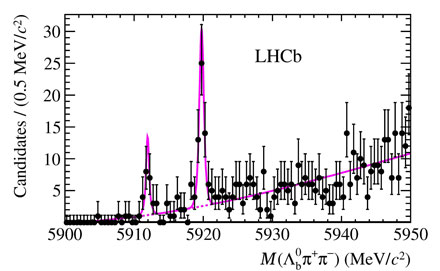
The new excited states show clear signals at masses of 5912 MeV/c2 and 5920 MeV/c2 (Image: LHCb collaboration)
The Large Hadron Collider beauty (LHCb) experiment at CERN today announced that it has observed two new excited states of the Λb beauty baryon. Though the Standard Model of particle physics predicts the existence of these new states, this is the first time they have been confirmed in an experiment.
Baryons are subatomic particles whose mass is equal to or greater than that of a proton. Like protons and neutrons, the Λb beauty baryon is composed of three quarks. In Λb these are up, down and beauty quarks.
LHCb physicists found the signals for the Λb particles in a sample of about 60 trillion proton—proton collisions which were delivered by the LHC operating at a centre-of-mass energy of 7 TeV in 2011. They measured the masses of the new excited states as 5912 MeV/c2 and 5920 MeV/c2 respectively - over five times greater than the mass of a proton or neutron.
The result adds to a growing list of discoveries at CERN in recent months. Last month the Compact Muon Solenoid (CMS) experiment observed a new excited state for the Ξb beauty baryon, and back in December 2011 ATLAS detected a new "quarkonium state" containing a beauty quark bound with its antiquark.
Find out more:
LHCb result
Other recent discoveries
14.05.2012: CERN welcomes its first choreographer in residence

The Moebius Strip © Cie Gilles Jobin 2007 (Image: Dorothée Thébert)
Space, time and gravity are under the cultural spotlight at CERN this month with the arrival of Gilles Jobin, the laboratory's first choreographer in residence and winner of the Collide@CERN Geneva prize, which is supported by the Canton and City of Geneva. Jobin is an internationally renowned Swiss choreographer with a company in Geneva. His CERN inspiration partner for his three-month residency at the laboratory will be the multi-media producer and visualisation specialist, João Pequenão, who studied physics at the University of Lisbon.
Find out more
09.05.2012: CERN computing looks to the future
![[IMAGE]](features/120509_GRID.jpg)
The Worldwide LHC Computing Grid (pictured: Tier-0 servers at CERN) will see increased capacity and development (Image: CERN)
It's been an exciting week for computing at CERN.
On Tuesday CERN signed a contract with the Wigner Research Centre for Physics in Budapest, Hungary, for an extension to the CERN data centre. Under the new agreement, the Wigner Centre will host CERN equipment to extend the capabilities of the Worldwide LHC Computing Grid (WLCG) – a global computing system organized in tiers, with its central hub, Tier-0, at CERN. Tier-0 provides some 30 petabytes (PB) of data storage on disk, and includes the majority of the 65,000 processing cores in the CERN Computer Centre. The Wigner Centre will extend this capacity with 20,000 cores and 5.5 PB of disk data, which will double after 3 years.
And today CERN launched the fourth phase of CERN openlab – a unique public-private partnership between CERN and leading information-technology companies. The initiative brings together science and industry to develop advanced IT systems to cope with the computing challenges related to the Large Hadron Collider. This fourth phase of the intiative will address cloud computing, business analytics, next-generation hardware, and security for network devices.
Computing is a crucial part of CERN's activities. Initiatives like these will help physicists deal with the torrent of data expected as the LHC reaches higher intensities and energies in the coming years.
Find out more
2 May
Forty years of the PS Booster
![[IMAGE]](features/120502_PS_Booster.jpg)
The Proton Synchrotron Booster in October 1972, just four months after being switched on for the first time (Image: CERN)
The Proton Synchrotron (PS) Booster – a key accelerator in the CERN complex – is 40 years old this month.
The accelerator is made up of four superimposed synchrotron rings that receive beams of protons from the linear accelerator (Linac) at 50 MeV and accelerate them to 800 MeV for injection into the Proton Synchrotron (PS).
Before the Booster received its first beams on 26 May 1972, protons were injected directly from the Linac into the PS, where they were accelerated to 26 GeV. The low injection energy of 50 MeV limited the number of protons the PS could accept. The Booster allows the PS to accept an order of magnitude more protons, which greatly enhances the beam's utility for experiments.
Find out more
27.04.2012: CMS discovers new particle – Meet the Ξb*0 beauty baryon
![[IMAGE]](../features/120427_Xi_b.jpg)
The Ξb*0 particle shows a clear signal (blue) above the background level (red) (Image: CMS)
The Compact Muon Solenoid (CMS) experiment at CERN has submitted a paper for publication describing the first observation of a new particle, an excited beauty baryon called the Ξb*0 (Ξb is pronounced "Csai - bee").
Baryons are subatomic particles whose mass is equal to or greater than that of a proton. The Standard Model of particle physics predicts the existence of Ξb baryons in charged, neutral or excited states. Though charged and neutral Ξb baryons have been seen in detectors before, this is the first time the an excited Ξb beauty baryon has been observed. CMS measured the mass of the new particle to be 5945.0 ± 2.8 MeV.
CMS physicists found the Ξb*0 signal in a sample of about 530 trillion proton—proton collisions (an integrated luminosity of 5.3 inverse femtobarns) which were delivered by the Large Hadron Collider (LHC) operating at a centre-of-mass energy of 7 TeV in 2011.
The Ξb*0 adds to a growing list of discoveries at CERN in recent months. In December the ATLAS experiment announced the observation of a new "quarkonium state" containing a beauty quark bound with its antiquark, and in November the LHCb experiment reported a new effect in the decays of particles containing a charm quark (or antiquark).
With the LHC now running at 4TeV per beam, the collision number is set to increase, which enhances the machine's discovery potential considerably, and opens up new possibilities for searches for new and heavier particles.
Find out more
24.04.2012: CERN supports new business incubation centre in the UK
![[IMAGE]](features/120424_handshake.jpg)
John Womersley of the Science and Technology Facilities Council (left) meets Steve Myers, CERN's Director of Accelerators and Technology (Image: STFC)
CERN and the UK’s Science and Technology Facilities Council announce the launch of a new Business Incubation Centre (BIC) at the STFC’s Daresbury Science and Innovation Campus. The centre will provide a new technology transfer opportunity to bridge the gap between basic science and industry, supporting businesses and entrepreneurs in taking innovative technologies related to high energy physics from technical concept to market reality.
More information:
23.04.2012: LHC reaches data milestone
In just three weeks of operation in "stable beams" mode, the Large Hadron Collider (LHC) has already delivered approximately one inverse femtobarn of data to the experiments - a measure of accelerator performance equivalent to 100 trillion proton-proton collisions. Last year, the LHC took three months to reach that amount. Stable beams mode enables the experiments to collect data for physics analysis.
The LHC is now operating at 1380 proton bunches per beam, the maximum value set for this year. It has also exceeded the maximum peak luminosity – a measure of the instantaneous collision rate – achieved last year: while the top value for 2011 was 3.6 × 1033 collisions per square centimetre per second, LHC has now reached 3.9 × 1033 cm-2 s-1.
The higher collision energy of 4 TeV per beam (compared to 3.5 TeV per beam in 2011) and the resulting higher number of collisions expected both enhance the machine's discovery potential considerably, opening up new possibilities for searches for new and heavier particles.
More information:
20.04.2012: CERN to host Swiss screening of One Day on Earth
![[IMAGE]](features/210412.jpg)
On 22 April the CinéGlobe international film festival at CERN will host the Swiss edition of the global screening of One Day on Earth, the first film to be shot and then screened in every country in the world. The film was created from over 3000 hours of footage, shot by the One Day on Earth community in every country of the world on 10 October 2010. The screening starts at 3pm and 5.30pm in the Globe of Science and Innovation. Running time: 1 hour and 45 minutes.
More information:
- For general enquiries contact presse@cineglobe.ch
- For specific inquiries about the One Day on Earth initiative, contact press@onedayonearth.org
See also:
Follow the project:
19.04.2012: LHC reaches 1380 proton bunches per beam
In just two weeks of operation in "stable beams" mode, the Large Hadron Collider (LHC) has aready reached 1380 proton bunches per beam, the maximum value set for this year. The number of bunches was increased in steps from 624 to then 840 bunches last week, and now from 1092 to 1380.
More information:
17.04.2012: LHC reaches record collision rate at 4TeV per beam
![[IMAGE]](features/120417_ALICE_detector.jpg)
Physicist Despina Hatzifotiadou inspects the wiring on the ALICE detector at the Large Hadron Collider (Image: CERN)
In just 12 days of operation in "stable beams" mode, the Large Hadron Collider (LHC) has already exceeded the maximum peak luminosity – a measure of the instantaneous collision rate – achieved last year. The LHC has now reached 3.9 × 1033 collisions per square centimetre per second, while the top value for last year was 3.6 × 1033 cm-2 s-1. Stable beams mode enables the experiments to collect data for physics analysis.
So far this year the total amount of data delivered to the experiments – the integrated luminosity – is now about 0.6 inverse femtobarn, a measure of accelerator performance equivalent to about 60 trillion collisions. Last year, it took about 12 weeks of operation to reach that number.
The number of proton bunches colliding in the machine is steadily increasing, with 1092 bunches per beam achieved so far. Over the coming days, this number will be increased to 1380 bunches per beam, the maximum value for this year.
This year, the higher collision energy of 4 TeV per beam (compared to 3.5 TeV per beam in 2011) and the resulting higher number of collisions expected both enhance the machine's discovery potential considerably, opening up new possibilities for searches for new and heavier particles. So keep an eye on us!
More information:
11.04.2012: LHC yields data rapidly at new collision energy of 8TeV
![[IMAGE]](../features/120411_CCC.jpg)
A physicist monitors beams in the LHC from the CERN Control Centre (Image: CERN, from the 2011 lead-ion run)
The Large Hadron Collider (LHC) resumed operating in "stable beams" mode at 00:38 CEST on 5 April, and is rapidly coming back up to speed. The LHC experiments need stable beams to collect data for physics analysis.
In its first 6 days of operation this year, the LHC has already reached a total integrated luminosity of 0.2 inverse femtobarns – a measure of accelerator performance equivalent to about 20 trillion collisions delivered to the experiments. Last year the LHC took six weeks achieve the same number.
The number of proton bunches in the machine – currently 624 per beam - will be increased over the coming two weeks, to 840, then 1092, and finally to 1380 bunches per beam, the machine's maximum for this year. The number of protons per bunch is also increasing.
This year's higher collision energy of 4 TeV per beam (compared to 3.5 TeV per beam in 2011) and the resulting higher number of collisions expected enhance the machine's discovery potential considerably, opening up new possibilities for searches for new and heavier particles. Watch this space!
More information:
05.04.2012: LHC physics data taking gets underway at new record collision energy of 8TeV
![[IMAGE]](http://press.web.cern.ch/press/PressReleases/Releases2012/images/PR10.12.png)
At 0:38 CEST this morning, the LHC shift crew declared ‘stable beams’ as two 4 TeV proton beams were brought into collision at the LHC’s four interaction points. This signals the start of physics data taking by the LHC experiments for 2012. The collision energy of 8 TeV is a new world record, and increases the machine’s discovery potential considerably.